

Mastering zero-defect handovers
The final weeks of a construction project are often the most chaotic. As multiple trades converge for close-out, the punch list becomes the primary mechanism for tracking outstanding deficiencies—and the primary bottleneck to releasing retainage and achieving practical completion. Teams that manage this phase with paper forms and spreadsheets consistently experience cost overruns, disputes, and delayed occupancy.
This article examines why traditional handover processes fail systematically, and how a structured digital QA/QC platform enables zero-defect handover at scale.
Why manual handovers fail on industrial projects
The root cause of delayed handovers is generally communication fragmentation. When a site superintendent walks the site with an architect, relying on paper blueprints, sticky notes, and phone cameras guarantees chaos.
This analog approach naturally creates severe operational bottlenecks:
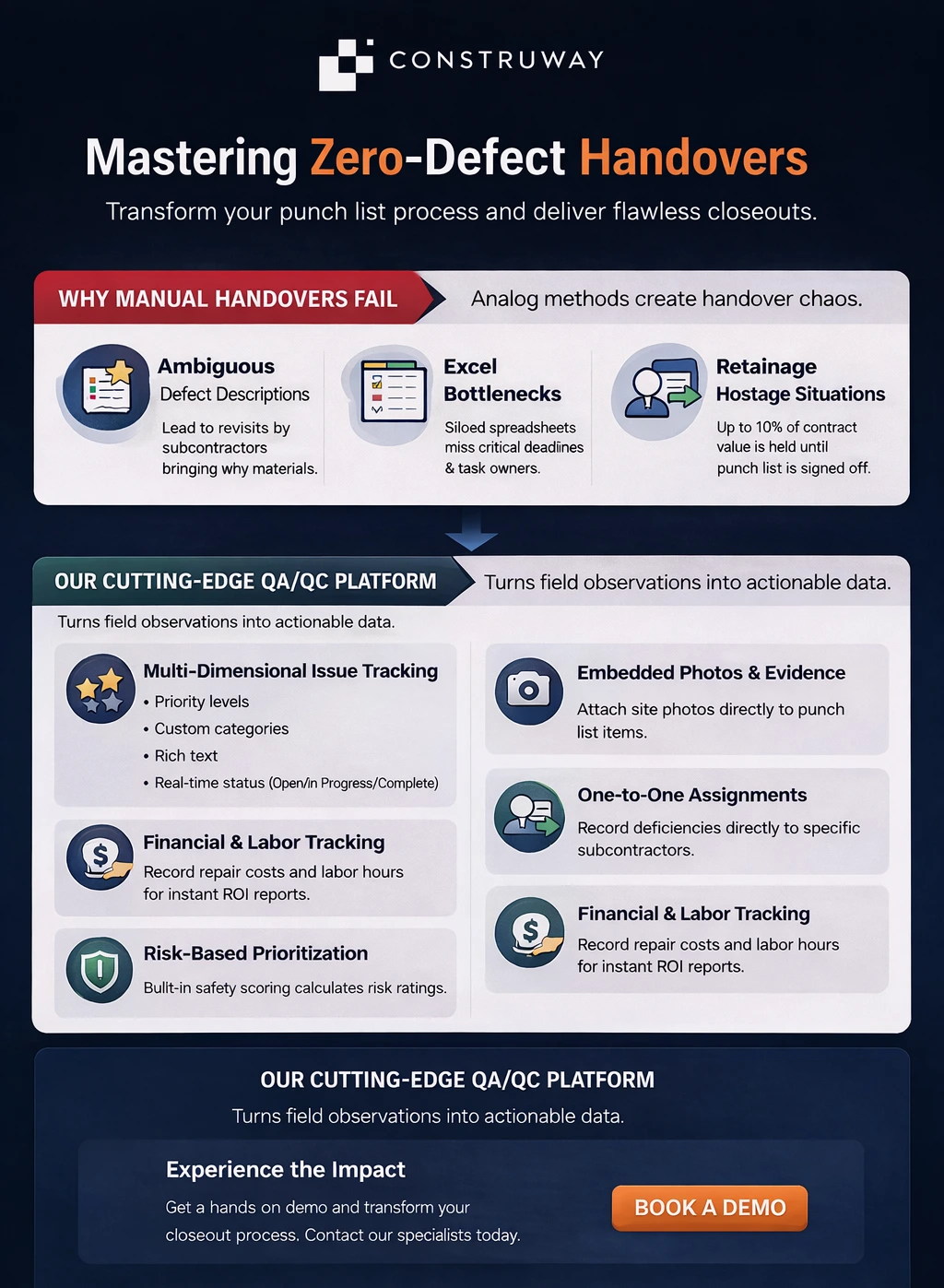
Ambiguous defect descriptions — "Fix drywall in room 204" leaves too much room for interpretation, leading to multiple trips by subcontractors who don't bring the correct materials.
No accountability loop — When defects are tracked in a standalone Excel sheet, there is no system to notify the corresponding trade partner automatically, nor is there a way to verify the fix immediately upon completion.
Retainage hostage situations — General Contractors often have up to 10% of their total contract value held in retainage until the punch list is explicitly signed off. Every day the punch list drags on is a day of negative cash flow.
How our platform transforms field observations into actionable data
Modern construction management requires a systemic approach to Quality Assurance and Quality Control (QA/QC). Our high-performance tracking system is designed specifically for close-out efficiency and accountability.
1. Multi-dimensional issue tracking eliminates ambiguity
Beyond simple checklists, each item captures priority (Low/Medium/High), custom categories, rich text descriptions, and real-time status (Open, In Progress, Completed). This ensures every defect is categorized by its actual impact on the project schedule.
2. Integrated multimedia evidence provides visual proof
Native support for field attachments allows teams to capture and link site photos directly to specific punch items. This provides an immutable record of non-compliance or successful remediation, eliminating "he-said-she-said" disputes.
3. One-to-one assignment logic ensures clear ownership
Accountability is built-in. Every deficiency can be pinned to specific team members or external sub-contractors. By creating a direct link between an issue and its owner, the system removes the bottleneck of centralized coordination.
4. Financial & Labor intelligence for ROI tracking
Our platform goes deeper than status tracking. Managers can record estimated vs. actual costs for repairs and track labor hours spent on-site to resolve issues. This provides valuable feedback for future procurement and subcontractor evaluation.
5. Risk scoring to prioritize life-safety
A built-in safety module calculates a Safety Rating based on the product of Severity and Occurrence. This allows managers to mathematically prioritize life-safety issues and critical risks over purely cosmetic defects.
The two-stage approval workflow: Eliminating the finish-line friction
The path to "Completed" is governed by a secure, two-stage mechanism:
- Formal Inspections: A dedicated interface for inspectors to record technical notes and verify that rework meets project specifications.
- Final Sign-off: An authorized 'Approver' must digitally sign off, automatically transitioning the item to "Completed" with an immutable timestamp and audit trail.
For large-scale handovers, our Bulk Approval interface allows project managers to review and sign off on multiple rectified items simultaneously, preventing administrative overhead from delaying the final certificate of occupancy.
The real cost savings: Where the ROI appears
By consolidating QA/QC workflows, project managers achieve radical transparency. Dashboards highlight which subcontractors are chronically holding up resolutions, and predictive analytics can warn project directors if defect rates threaten the target handover date.
Slashing closeout time by just two weeks can free up critical supervisor resources for new projects, release millions of dollars in retainage faster, and build lasting, trust-based relationships with clients.
Stop fighting your project at the finish line. Book a demo to see our mobile-first defect management platform in action.
Frequently asked questions
A rolling punch list is a continuous quality control approach where defects are identified, logged, and resolved concurrently as construction phases progress, rather than waiting for a single massive review at the end.
A zero-defect handover minimizes client friction, protects profit margins from endless rework labor, accelerates the release of retainage funds, and allows the general contractor to demobilize their site team promptly.
Digital punch lists remove ambiguity by providing exact locations, photos, and automated notifications. Because subcontractor performance is tracked mathematically, they are motivated to resolve issues quickly to avoid SLA penalties and secure final payments.
Related articles
Deep dives into the tools and strategies that keep capital projects on track.