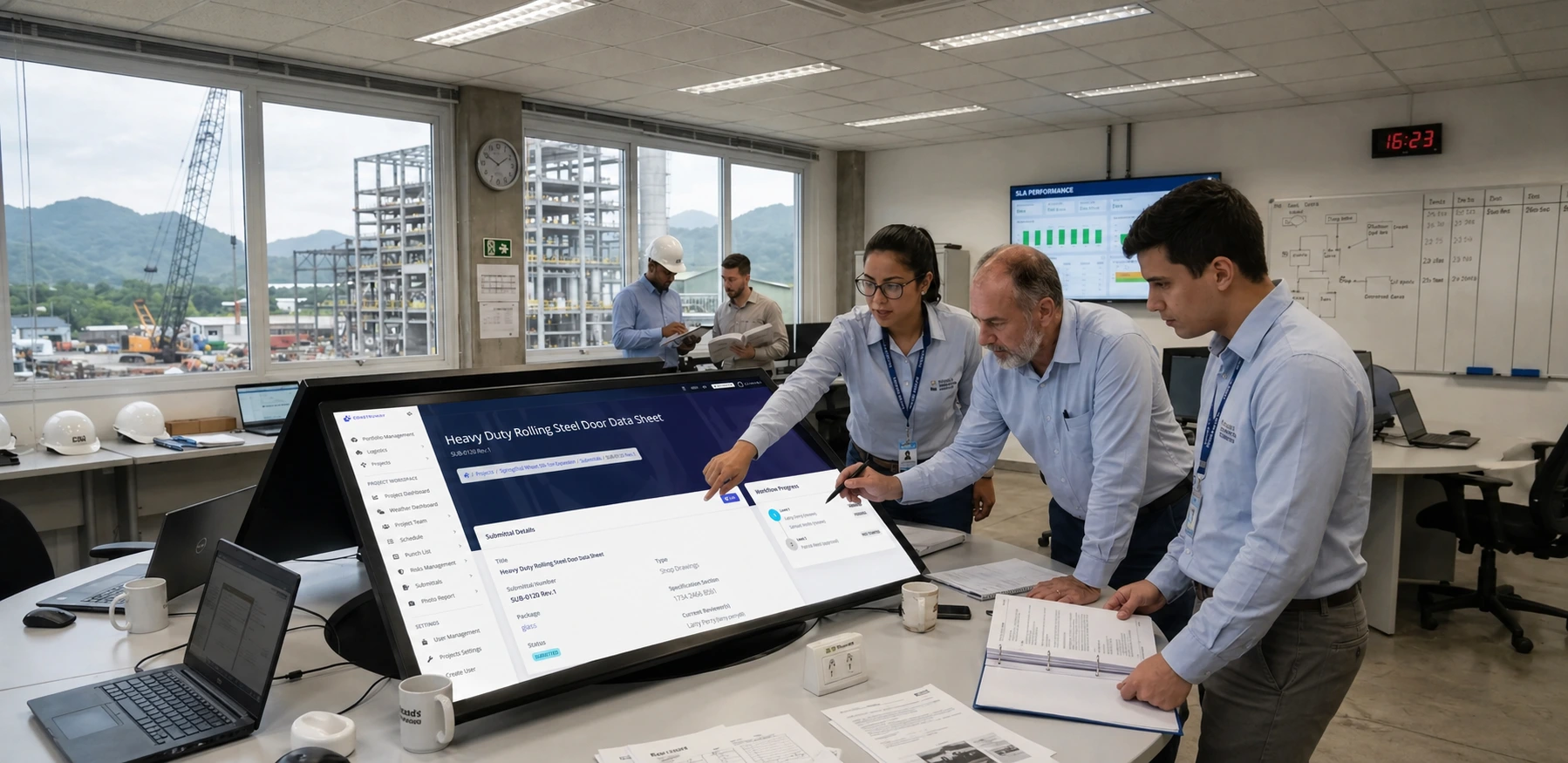
The hidden cost of outdated submittal workflows in industrial projects
On large-scale industrial projects, submittal management is the invisible backbone of quality control and regulatory compliance. Yet most project teams still handle submittals through fragmented email chains, shared drives, and manual spreadsheet trackers—creating a process that is simultaneously the most critical and the most error-prone workflow on the job site.
This article examines why outdated submittal workflows create compounding costs across the project lifecycle, and how automated submittal management fundamentally changes the economics of industrial construction.
Why manual submittal workflows fail at scale
A typical industrial construction project—petrochemical facility, data center, or heavy manufacturing plant—generates thousands of submittals across structural, mechanical, electrical, and instrumentation disciplines. Each submittal moves through a multi-step approval chain involving the contractor, engineer of record, owner's representative, and sometimes a third-party inspector.
Manual workflows create three compounding failures that scale exponentially with project size:
Version confusion and uncontrolled revisions — When submittals are tracked in shared folders and email, there is no authoritative system of record. Teams routinely fabricate from superseded drawings because they cannot confirm which revision was approved. On a single mechanical package, this can mean rework costs that dwarf the original procurement budget.
Approval limbo and untracked SLA breaches — When a submittal is "sent to the engineer," it disappears into an inbox with no structured tracking. Whether the engineer has 3 days or 14 days to review is rarely enforced. The result: submittals stall for weeks without triggering any escalation, and the procurement or fabrication schedule slips silently.
Zero accountability for non-compliance — When an inspector eventually discovers a discrepancy between the installed equipment and the approved submittal, determining who approved what revision—and when—requires forensic email archaeology. Without an immutable audit trail, disputes between contractor, engineer, and owner escalate into formal claims.
How automated submittal workflows solve each failure
The solution is not replacing email with a shared inbox tool. It is implementing a structured submittal engine with revision control, SLA enforcement, role-based routing, and immutable audit trails built into the data model.
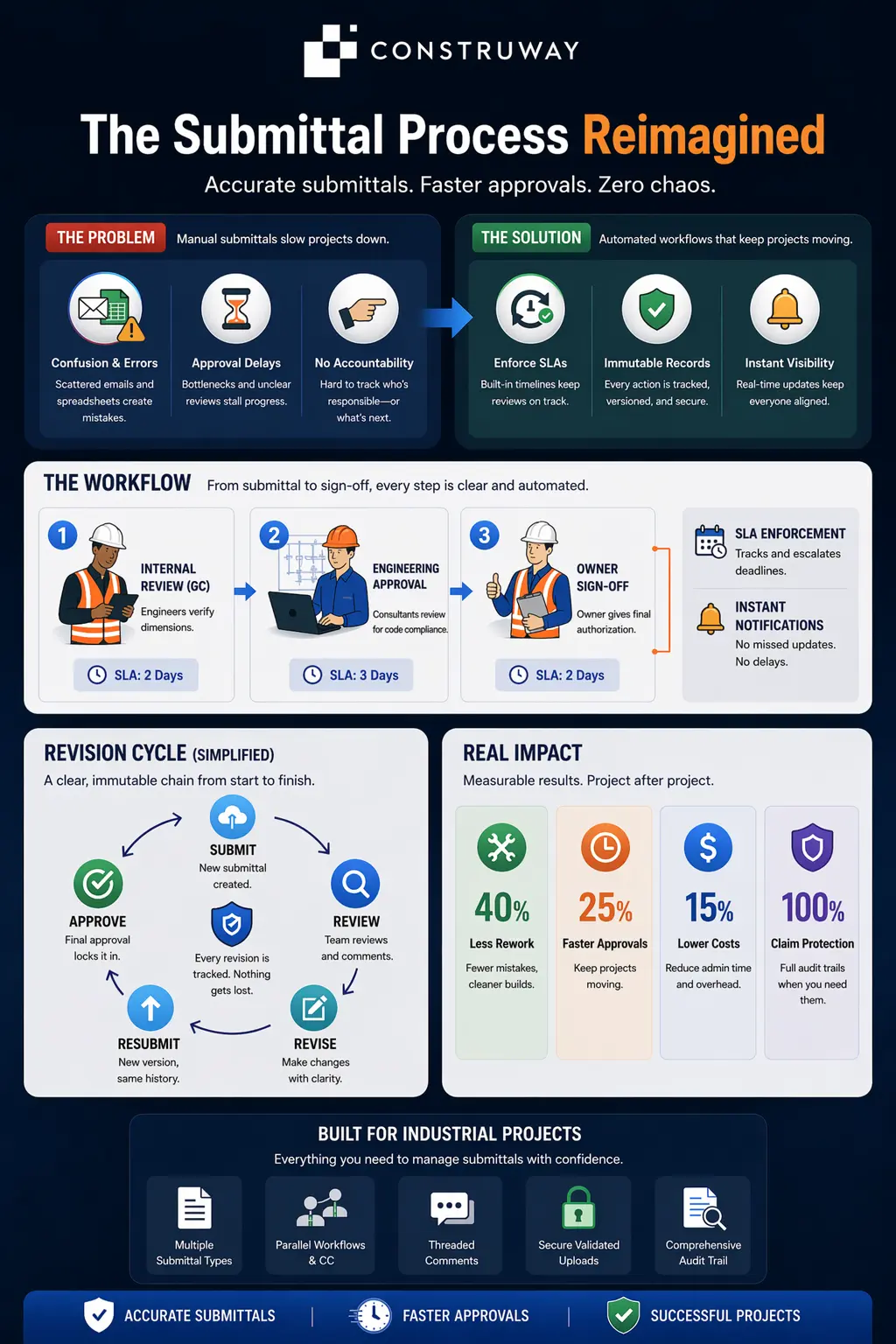
Submittal packages with grouped multi-discipline routing
Instead of managing individual submittals in isolation, the platform groups related items into packages with a defined scope, responsible discipline, and due date. This enables the project controls team to track all structural steel submittals as a single deliverable milestone rather than chasing 40 individual items across separate email threads.
Multi-level SLA enforcement with automated escalation
Each review stage carries a configurable SLA. When the mechanical engineer's 10-day review window is exceeded, the breach is logged and visible to anyone who checks the platform—giving the project manager and responsible parties a clear, centralized record to act on. This transforms SLA compliance from a forensic exercise in email archaeology into a transparent, searchable system of record.
Immutable revision chains with controlled supersession
When a submittal is revised, the previous revision is archived—not deleted. The platform maintains a complete, timestamped revision history showing who submitted, who reviewed, what decision was recorded, and which revision is currently governing. This eliminates version confusion and provides the forensic documentation needed for dispute resolution.
Granular status tracking across the approval lifecycle
Submittals move through structured states: Draft, Submitted, Under Review, Approved, Approved as Noted, Revise and Resubmit, and Rejected. Each transition is timestamped and tied to a named user. Dashboard views aggregate status across all packages, giving project managers a real-time picture of what is blocking procurement and fabrication.
The ROI of structured submittal management
The cost of poor submittal management is typically invisible until it produces a claim, an NCR, or a schedule extension. By the time a non-conformance is discovered in the field, the contractual damage has already been done—the fabricated item is installed, the inspector is on-site, and the options are limited to costly rework or formal variance documentation.
Structured submittal workflows eliminate these costs upstream by ensuring that approvals are tracked, revisions are controlled, and SLA breaches are surfaced before they cascade into procurement delays. On a project with 2,000 submittals and a 14-day average review cycle, reducing SLA breaches from 30% to 5% recovers hundreds of engineer-hours and weeks of schedule float.
Industrial-grade platform for complex approval chains
Industrial projects involve multi-tier approval chains that consumer-grade document tools cannot model. An instrument datasheet may require sequential review by the contractor's engineering team, the owner's process engineer, a third-party inspection agency, and the original equipment manufacturer—each with different SLAs and different authority levels.
The platform supports unlimited review tiers with configurable authority levels. Role-based access control ensures that only authorized users can record approval decisions, and every decision is logged with the reviewer's identity, timestamp, and any attached comments or markups.
A real-world scenario: Petrochemical piping package
Consider a piping contractor managing 800 submittals for a process unit expansion. Without structured workflow management, their project controls team spends four hours per day manually updating a shared spreadsheet and chasing status confirmations from the client's engineering firm.
With an automated submittal platform, that same team monitors all 800 submittals from a single dashboard and produces compliance reports for client meetings in minutes rather than hours. The reduction in administrative overhead alone—roughly 20 hours per week—recovers significant project controls cost over a 12-month execution period.
Conclusion
Submittal management is not a back-office administrative function—it is a direct driver of project schedule, quality compliance, and dispute risk. Continuing to manage submittals through email and spreadsheets on industrial-scale projects is a structural liability.
Automated workflows with structured revision control, enforced SLAs, and immutable audit trails transform submittals from a source of schedule risk into a controlled, documented process that protects all parties and accelerates project delivery.
Ready to eliminate submittal bottlenecks? Book a demo to see the platform in action.
Frequently asked questions
A submittal is documentation submitted by the contractor for engineer-of-record review and approval before fabrication or installation proceeds. Common submittal types include shop drawings, material data sheets, equipment specifications, test reports, and product samples.
Revision control ensures fabrication and installation always proceed from the currently approved revision. Without controlled revision tracking, teams frequently work from superseded documents — leading to non-conformances, rework, and schedule disruption that far outweigh the cost of structured document control.
A submittal SLA (Service Level Agreement) defines the maximum number of days each review party has to complete their review and record a decision. When a deadline is exceeded, the breach is logged and visible in the platform, so the responsible party can identify stalled items and take action before the procurement or fabrication schedule is impacted.
By maintaining an immutable, timestamped record of every submittal decision and revision, the platform provides forensic documentation that resolves disputes before they escalate to formal claims. Both the contractor and owner can verify exactly what was approved, by whom, and when.
Yes. Submittals can be grouped into packages by discipline, system, or procurement package. Each package maintains its own status, deadline, and revision history, giving project managers a structured view of submittal progress at the deliverable level rather than individual item level.
Related articles
Deep dives into the tools and strategies that keep capital projects on track.